
When you provide out-of-network care under the No Surprises Act, getting paid fairly depends on how well you manage the claim process. The system follows strict rules, deadlines, and documentation standards. When your team handles those pieces correctly, you improve your chances of a stronger payment. But when those pieces are weak or inconsistent, underpayments become much more common.
You’re already delivering the care. The next step is making sure the claim is prepared and submitted in a way that supports full reimbursement. Providers who do well under the NSA usually take a structured approach to arbitration instead of treating each dispute like a last-minute response. The gap between a low recovery and a stronger one often comes down to early preparation and consistent execution.
If you want to maximize your out-of-network claim recovery under the No Surprises Act, start by understanding what arbitrators look for. Once you know that, you can shape your documentation, bundling decisions, and filing timeline around the factors that actually influence the outcome.
Understanding How Revenue Is Determined Under the NSA
Under the NSA, a payment dispute follows a set path. First, you submit the claim. Then the payer sends an initial payment or denial, and the 30-day open negotiation period begins. If that period ends without a resolution, either side can start Independent Dispute Resolution (IDR). At that point, an arbitrator reviews both payment offers using the factors laid out in the law.
Your claim becomes stronger when your submission clearly shows why your requested amount reflects the proper out-of-network value. Arbitrators look at factors like the Qualifying Payment Amount, the complexity of the service, the patient’s acuity, the provider’s experience, and local market conditions. They also pay close attention to how well your documentation supports those points. If the evidence is incomplete or hard to follow, the payer’s offer often has an easier path.
To improve results, shape your claim around the factors arbitrators actually review. A clear, organized case carries more weight than broad statements about fairness or cost. For even better chances, look into recruiting IDR help by arbitration experts who know exactly how to frame your claims.
Documentation as a Revenue Multiplier
Strong documentation has a direct impact on how much you recover. Every document you include should help prove that your requested payment matches the care you provided.
You get better results when your documentation stays consistent from start to finish. Your coding, clinical notes, and supporting records should all point to the same story. If those pieces don’t line up, the arbitrator has more reason to question your claim. Clear records make it easier for the arbitrator to understand your argument without guessing what’s missing.
Good documentation also helps you stay ahead of payer pushback. If you address common insurer arguments early, such as service classification or bundling issues, you make those objections less effective later. Your claim becomes stronger when the records answer likely questions before they turn into problems.
Using Bundling Strategically, Not Automatically
Bundling can be useful in NSA arbitration, but it needs to be done carefully. If you automatically bundle claims without reviewing them first, you might unknowingly reduce the amount you recover. But when you bundle claims with a clear strategy, you can make your case stronger.
Bundled claims work best when they reflect the same episode of care and share the same medical and timing context. Arbitrators tend to respond well when bundling makes the claim easier to understand and review. If the services are tied together by medical necessity, timing, and clinical details, bundling can help show the full scope of the care you provided.
Problems start when unrelated services are grouped together. That makes it easier for the payer to challenge the claim and harder for the arbitrator to follow your logic. To get the best result, look at whether bundling makes the value of the claim clearer or harder to understand. Each bundling decision should support how the case will be reviewed in arbitration.
Timing Decisions That Protect Revenue
The NSA timeline leaves very little room for error. If you miss a deadline, you can lose leverage and, in some cases, lose the chance to recover more revenue at all. You get better results when you treat timing as part of your revenue strategy, not just as an administrative detail.
The 30-day open negotiation period is especially important because it sets up the rest of the dispute. How you respond during that window affects how the payer views the claim and how the case will look if it moves into arbitration. Late, incomplete, or inconsistent submissions can weaken your position before the formal review process even starts.
Once the IDR filing window opens, speed and accuracy matter even more. If you want strong submissions, be sure to prepare, review, and file them in a controlled way. Rushed work often leads to missing details, and delays can create procedural problems that hurt your recovery. Protecting revenue starts with staying on top of the timeline from the first payment or denial onward.
How Arbitrators Evaluate Value
Arbitrators compare two numbers: your offer and the payer’s offer. They don’t create a middle-ground amount. That means your offer needs to look reasonable, well supported, and easier to accept than the payer’s.
You improve your chances when your submission is clear and logical. Explain the complexity of the service, the patient’s condition, and the provider’s expertise in a way the arbitrator can follow quickly. Broad claims and overly technical language make your argument harder to trust.
Organization also matters. A clean, well-structured submission is more persuasive because it helps the arbitrator move through the case without confusion. When your presentation is easy to follow, it becomes easier for the arbitrator to choose your number.
Common Revenue Leaks in NSA OON Claims
A lot of NSA revenue loss comes from the same mistakes happening over and over, not from one-off problems. When you spot those patterns, you can fix them in a more reliable way.
Missing or weak documentation makes claims harder to defend because key details about value are left unsupported. Poor bundling decisions can also hurt you by making the claim harder to understand and easier for the payer to challenge. Missed deadlines create even bigger problems because they reduce your leverage and can shut down recovery options completely.
The solution is a better process, not a case-by-case scramble. When your team handles claims in a consistent way that matches how arbitration actually works, your recovery becomes more stable and predictable.
Integrating NSA Strategy Into Your Revenue Cycle
You get better results from NSA claims when they’re part of your normal revenue cycle process instead of being handled as a separate project. When your team understands how NSA rules affect documentation, coding, and follow-up, claim quality improves earlier in the workflow.
It also helps when everyone follows the same approach. Clear standards for documentation, bundling, and escalation timing reduce inconsistency and make claims easier to defend in arbitration. That consistency strengthens your position and leads to more predictable outcomes.
Over time, this turns NSA claims into a steady revenue process rather than a last-minute dispute response.
Applying These Principles Across Different Care Settings
NSA out-of-network claims can look different depending on the care setting, but the core revenue principles stay the same. Emergency services, surgical care, and facility-based services each need their own type of documentation and valuation support.
You get better results when you match the claim presentation to the type of care involved while keeping your arbitration approach consistent. Emergency claims need clear documentation of patient acuity. Surgical claims need records that clearly support the complexity of the procedure. Facility-based claims need a clean distinction between the professional side and the facility side of the bill.
The goal is to adjust your strategy to fit the claim without losing structure. That balance helps you present stronger cases across different service settings.
Building Predictable Outcomes Over Time
Maximizing revenue from NSA out-of-network claims depends on building a process you can repeat, not on chasing one good result at a time. A strong system gives you more reliable outcomes across many claims.
You create more predictability when your team handles documentation, bundling, and deadlines the same way every time. That consistency reduces payer pushback, makes arbitration more efficient, and helps more claims move forward cleanly. Over time, the result is steadier cash flow and fewer claims stuck in limbo.
When you manage NSA claims with structure and discipline, they become a dependable part of your revenue strategy instead of an ongoing source of uncertainty.
Video
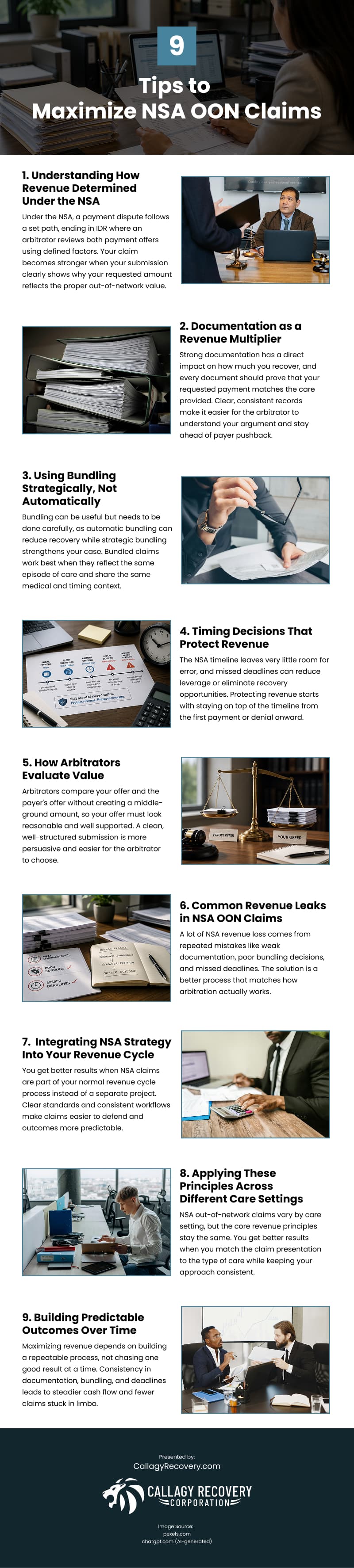
Infographic
Maximizing recovery of out-of-network claims under the No Surprises Act (NSA) requires a strategic approach that considers several key factors. This infographic provides tips to enhance the recovery of out-of-network claims.