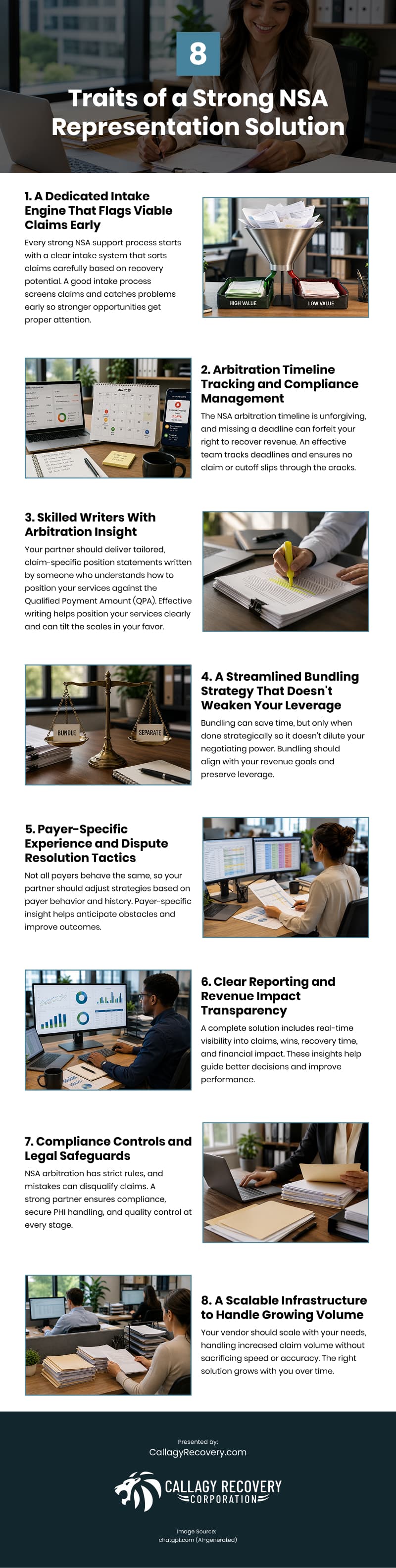

When you’re juggling denied claims, mounting underpayments, and the rigid timelines of the No Surprises Act (NSA), you need more than just a filing service. You need a strategic partner. A strong third-party NSA representation solution doesn’t just process paperwork; it strengthens your leverage and protects your revenue all on a quick timeline.
But what should you actually expect from a high-performing NSA support solution? Let’s break it down into the essential components so you can spot the difference between a true recovery ally and a glorified admin vendor.
1. A Dedicated Intake Engine That Flags Viable Claims Early
Every strong NSA support process starts with a clear intake system. You want a partner who can sort claims carefully, because some claims have much better recovery potential than others.
A good intake process should screen claims based on factors like likely financial value, payer behavior, and whether the documentation is strong enough to support arbitration. It should also catch problems early, such as missed deadlines, duplicate filings, or unclear coding. And it should connect smoothly with your billing or EHR systems so your team doesn’t waste time pulling the same data by hand.
If a partner accepts every claim without that kind of review, you may be spending time and arbitration resources on weak cases while stronger opportunities get less attention. Good triage is often where leverage starts.
2. Arbitration Timeline Tracking and Compliance Management
The NSA arbitration timeline is unforgiving. You’ve got 30 business days for open negotiation, and only 4 days to submit a final offer once that window closes. A missed cutoff can forfeit your right to fight back.
That’s why an effective arbitration representation team for medical groups must operate as your timeline watchdog. Your team should track negotiation and IDR filing windows and have internal escalation processes in place if responses stall. You need peace of mind knowing that no viable claim gets lost in the shuffle and no deadline slips through the cracks.
3. Skilled Writers With Arbitration Insight
What you submit to the arbitrator is vitally important. And yet, many third-party vendors use copy-paste templates that never evolve or address payer-specific nuances.
Your partner should deliver tailored, claim-specific position statements written by someone who understands how to position your services against the Qualified Payment Amount (QPA), how to include relevant supporting documentation, and what arbitrators look for when choosing between offers.
Effective writing can tilt the scale in your favor, especially when dealing with repeat payers or complex clinical services like anesthesia, trauma care, or surgery.
4. A Streamlined Bundling Strategy That Doesn’t Weaken Your Leverage
Bundling similar claims can save time and reduce administrative costs, but only when done strategically. If bundling is done purely for operational convenience, it may dilute your negotiating power.
A strong NSA representation partner understands the balance. They know when to bundle multiple claims under the same provider, CPT code, and date range. They also understand when to separate claims to preserve your leverage as well as how to ensure each claim in a bundle still meets the IDR eligibility requirements.
Bundling shouldn’t be a shortcut; it should be a tactic. And it must align with your revenue goals, not just the vendor’s efficiency metrics.
5. Payer-Specific Experience and Dispute Resolution Tactics
Not all payers behave the same way during arbitration. Some respond quickly while others drag their feet. Some have consistent QPA calculations; others don’t. The partner you choose should be able to speak to payer behavior and adjust accordingly.
Look for a vendor who can tell you which payers settle before IDR and when to press harder, and which CPT codes consistently require more documentation. Your chosen partner should also be transparent about what their historical win rates are by payer. This level of payer-specific insight helps you anticipate obstacles before they slow you down.
6. Clear Reporting and Revenue Impact Transparency
If you’re outsourcing NSA claims, you deserve more than vague updates. A complete representation solution includes real-time visibility into your performance.
You should receive reports that show:
- Claims submitted, pending, and resolved
- Arbitration wins and award amounts
- Average recovery time and payout per CPT code or service type
- Financial impact on a monthly or quarterly basis
These numbers matter, not just for finance, but for making future decisions on case selection, documentation improvement, and payer negotiations.
7. Compliance Controls and Legal Safeguards
NSA arbitration is governed by strict rules. Submissions must meet formatting requirements, use specific documentation types, and include all payer correspondence. A mistake can disqualify your claim.
Your third-party partner should be compliant with federal arbitration formatting standards and familiar with jurisdiction-specific protocols, especially in hybrid states. They should also be equipped to store and manage Protected Health Information (PHI) securely.
Ask how they track and audit their own performance. Do they have QA processes for each stage of the dispute? Do they routinely update their templates based on arbitrator feedback?
This isn’t just about winning. It’s about protecting your practice from avoidable mistakes.
8. A Scalable Infrastructure to Handle Growing Volume
Your arbitration needs today may look very different six months from now. That’s why your vendor must be ready to scale. Whether you’re managing 25 monthly claims or 250, the solution should grow with you without sacrificing speed or accuracy.
Scalability includes:
- Staff resources to handle intake, writing, and filing at scale
- Technology infrastructure that supports batch processing and auto-reminders
- Strategic support to adapt to new service lines, payers, or state law changes
You shouldn’t have to switch vendors every time your volume increases. The right one is built to grow with you from the start.
Put It All Together: A System, Not a Shortcut
A true NSA representation solution is more than a claim-filing service. It’s a coordinated system designed to help you win more disputes, avoid costly delays, and recover revenue that’s rightfully yours.
When evaluating a third-party partner, use this checklist. Look beyond the buzzwords. Ask tough questions. And don’t settle for a vendor who only solves for speed at the expense of strategy.
This process impacts your bottom line. You deserve a team that understands both the technical requirements and the business impact of each claim you pursue.
Video
Infographic
When managing denied claims and underpayments under the No Surprises Act, it’s essential to have a strategic partner rather than just a filing service. This infographic highlights the traits of a strong representation solution for the NSA.