
Winning a federal IDR decision under the No Surprises Act should feel like the finish line. But even after you win, payments can arrive short, show up late, or not arrive at all. Your team ends up spending more time chasing money that was already awarded and you should have received. Those delays slowly turn into staff frustration and added pressure on your accounts receivable process. You may even end up simply giving up on ever getting payments.
The rules give providers real leverage, but only when they’re applied consistently. Once a certified IDR entity issues a determination, the payer has 30 calendar days to send payment. On paper, that seems simple. In practice, payers may still delay through so-called processing errors, incorrect claim numbers, refund offsets, or vague requests that create unnecessary back-and-forth.
The key is to make enforcement part of a standard workflow. A favorable IDR determination should be treated like any other receivable, with clear documentation, tracking, and escalation steps. When you employ NSA recovery services to structure your process, payment becomes something your team manages systematically instead of something they wait and hope for.
Start With the Timeline That Actually Controls Payment
Start with learning about and enforcing clear dates. Under the federal IDR process, the timeline you should focus on begins when the certified IDR entity sets out its decision. At that point, your 30-day window to argue your case and receive payment begins. If you can’t point to the decision date and prove it, you’re arguing from memory, which won’t hold up against the payer.
You also want the earlier dates organized, because delays often trace back to them. Plans generally have 30 calendar days to send an initial payment or denial after the bill is submitted, and the open negotiation and initiation windows follow from that sequence. When a payer claims your case is out of sequence, you can respond with a simple, time-stamped chain instead of getting back into an old argument.
Why Payers “Win” After You Win
Most post-award delays fall into a few repeatable patterns. The payer might issue payment under the wrong claim number, apply it to a different encounter, or bury it in a bulk remittance that your posting workflow doesn’t associate with the determination. You may also see partial payment that looks close enough to pass a quick glance, especially when multiple service lines are involved.
Offsets create another common problem. A payer may attempt to recoup through a separate adjustment, which forces you to reconcile what’s tied to the IDR decision versus what is unrelated. When your tracking is loose, you spend weeks proving that their adjustment is not the same thing as satisfying the amount due.
The fix is rarely a single aggressive email. You get paid more often when your enforcement is consistent and supported by documentation that makes it easy for the payer’s operations team to process without interpretation.
Build a Simple Enforcement Packet You Can Send in Minutes
You want a standard packet that your team can assemble quickly every time without reinventing it. When you respond quickly and consistently, you shorten the window where delays become normal.
Here’s a practical packet structure you can keep as a template:
- Decision proof and payment math. Include the IDR determination, the decision date, and a one-paragraph calculation that shows the amount due net of any initial payment already made. Keep it readable so a payer rep can forward it internally without rewriting it.
- Claim identifiers that match payer systems. Provide the claim number, member identifiers as appropriate, date of service, facility/provider identifiers, and the service codes involved. Payment often fails because one identifier doesn’t match what the payer uses in its internal queue.
- Posting evidence and a clear ask. Add the remittance detail if a partial payment posted, then state exactly what you want next: full payment, corrected payment, or a written explanation of how the payer applied the determination.
That packet becomes your default response to “We’re looking into it,” and it keeps your team from writing a new narrative every time.
Reconcile Payment the Way a Payer Processes It
A payer may mark a claim as “paid” while your AR still shows it as unpaid simply because the payment was applied incorrectly. Closing that gap means reconciling the payment the same way the payer does, then mapping it back into your own system accurately.
Start by matching the IDR determination to the remittance at the line-item level, not just by the total amount. If the payer issued a lump-sum payment, trace it using the IDR case reference, claim number, or any internal adjustment codes connected to the encounter. Sometimes the payment is applied to a parent claim or a corrected claim instead of the original one. When that happens, document the connection clearly so you can show the payment trail from start to finish.
If you uncover a mismatch, avoid framing it as an argument over fairness. Treat it as an operational issue that needs correction: “This determination matches X identifiers, but payment was applied under Y. Please reapply the payment to the correct claim or issue the remaining balance.” Keeping the conversation focused on processing and reconciliation helps move the issue through operations faster.
Make the 30-Day Mark a Trigger, Not a Reminder
If you wait until late to start pushing, you lose time. Build triggers at day 10, day 20, and day 30 after the decision date. The earlier touches can be lightweight, and they often prevent the “lost in the queue” problem.
On day 10, your message can be simple: confirm the payer has the determination, confirm the claim identifiers they’re using, and request a projected payment date. On day 20, send the enforcement packet again and ask for confirmation that payment is scheduled. On day 30, shift to escalation language that stays factual: the decision date, the amount due, and the requirement to pay within 30 calendar days.
This approach turns enforcement into a calendar-driven workflow your team can run at a large scale, which matters if you rely on NSA recovery services to keep out-of-network revenue from leaking.
Escalate Through the Channels That Create Accountability
Some payers respond as soon as you copy the right internal mailbox. Others require external accountability. The federal guidance notes that if a party believes the other party is not in compliance with the balance billing protections, a complaint may be filed with the No Surprises Help Desk. In practice, you want to reserve escalation for cases where your documentation is clean and the payer has had a fair chance to process payment.
Escalation works best when you can attach your timeline and your enforcement packet, because it shows that the issue is not confusion but execution. You also protect your team from endless rework, because each escalation step is backed by the same standardized record.
If you’re operating across multiple states, you may also choose to align payer escalation steps with your broader dispute workflow, especially when a claim could route through state processes instead of the federal path. Keep that routing logic documented so your team doesn’t escalate the wrong way on the wrong type of claim.
Prevent Repeat Problems With a Post-Award “Closeout” Routine
The fastest way to get paid on the next award is to close out the last one cleanly. Build a closeout routine that includes the following:
- Confirming the final paid amount
- Documenting how it posted
- Saving the remittance evidence
- Tagging the payer behavior you observed (late, partial, misapplied, clean)
Over time, patterns emerge. You’ll know which payers require more identifier detail, which ones routinely use offsets, and which ones respond only when you push at day 20 instead of day 30. That data helps you forecast cash, reduce follow-up labor, and prioritize which awards need the most attention.
A Forward-Looking Way to Treat Enforcement
If you treat IDR wins as “done,” you’ll keep leaking time and revenue after the decision. If you treat them as receivables with a defined enforcement path, payment becomes more predictable. The teams that scale NSA performance usually aren’t doing anything flashy. They’re running a repeatable workflow, tightening identifiers, and escalating only when the record is airtight.
When you tighten enforcement, you don’t just collect one award. You set expectations for the next dispute, and you make your revenue cycle calmer in the places it typically gets noisy.
Video

Infographic
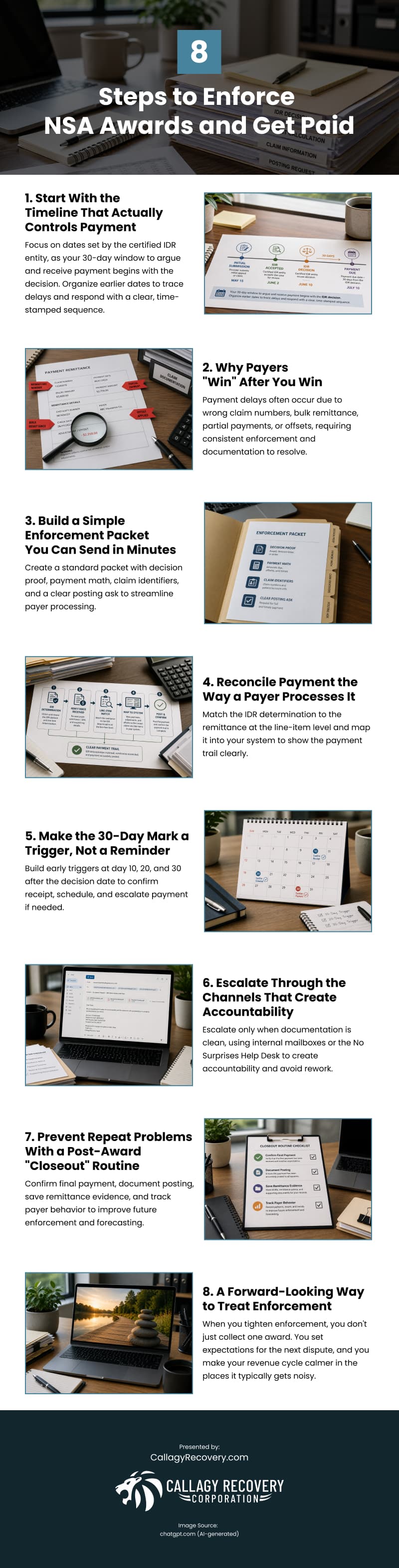
Winning a federal IDR decision under the No Surprises Act is significant, but payment isn’t guaranteed. Many providers face delays, partial reimbursements, or no payment. This infographic outlines the steps needed to enforce NSA awards and secure the compensation owed.