
When you move a dispute into Federal IDR, most of your attention goes to documentation, timing, and payment strategy. It might feel like you have no time left to search for a decent arbitration representation partner, so you end up choosing the first one that fits in your budget.
The problem with going this route is that your arbitration partner’s operations play a massive role in your reimbursement rates. The partner’s pace, communication style, and handling of procedural issues can affect how smoothly your case moves and how much internal effort your team spends managing it.
Arbitration representation providers aren’t equal or interchangeable. Some move faster. Some communicate more clearly. Some handle administrative questions with less friction. If your team files large volumes of cases, those differences add up. The right medical claim arbitration representation partner can reduce delays, improve visibility, and make the overall process easier to manage.
That doesn’t mean you should chase reputation alone. You need a practical way to compare providers based on the factors that affect workflow, efficiency, and long-term support.
Start With Responsiveness, Not Marketing Language
The first thing to evaluate is responsiveness. You want to know how quickly a representation partner acknowledges new matters, responds to questions, and moves procedural steps forward. A slow response at the wrong point can create avoidable follow-up work for your team and leave claims sitting unresolved longer than necessary.
Ask your internal team or colleagues what they have actually experienced. Which partners return messages promptly? Which ones create bottlenecks? Which ones communicate clearly when there’s a filing issue or a missing document? When you’re trying to predict how the partner will perform once disputes are underway, real-world experience matters more than polished sales materials.
You should also pay attention to consistency. One quick response doesn’t tell you much, but a repeated pattern does.
Look at Historical Trends in Case Handling
Historical trends help you move from impression to pattern. If your organization has worked with multiple representation providers, review how they have performed over time. Some may move cases through preparation and filing more efficiently. Others may require more follow-up or take longer to resolve administrative issues. Those differences affect forecasting, payment timing, and the amount of oversight required from your team.
You aren’t simply evaluating whether a partner can submit a dispute. The stronger question is how it manages the process surrounding the dispute. Does it maintain organized records? Does it communicate proactively? Does it keep claims moving through the pipeline? These operational qualities are vital to evaluate. A smoother process allows your team to focus on reimbursement strategy rather than administrative tasks.
This is where internal tracking becomes valuable. If you aren’t already documenting partner performance, start now. Even simple notes can reveal useful patterns over time.
Focus on Administrative Discipline
A good medical claim arbitration support partner should help keep the dispute process organized. That includes maintaining clear documentation, tracking deadlines, managing submissions, and communicating procedural requirements effectively. You want a partner that supports structure rather than creating additional work for your staff.
Administrative discipline becomes even more important when claim complexity increases or dispute volume grows. If a partner repeatedly creates confusion around what was submitted, what is still needed, or where a claim stands in the process, your team will spend unnecessary time correcting avoidable issues. That’s more than an inconvenience; it’s an operational problem.
You can often identify this early by reviewing how clearly the partner documents activity and how easy it is to reconcile its updates with your internal records.
Compare Communication Quality
Responsiveness tells you how quickly a partner replies. Communication quality tells you how useful that reply is. You want direct answers, clear guidance, and updates that help your team understand what happens next. Even if a partner is quick with responses, vague answers will still slow your progress.
This becomes especially important when a dispute encounters a procedural issue. If something needs correction, you want the representation partner to explain the situation in a way that allows your team to act efficiently. Weak communication means your staff has to spend extra time interpreting instructions or requesting clarification. Strong communication, however, reduces unnecessary back-and-forth and keeps matters moving forward.
If you’ve worked with multiple providers, compare them directly on this point. Which ones offer clear responses? Which ones create confusion?
Consider Volume Fit
Some representation partners may work well for occasional filings but struggle as dispute volume increases. If your organization handles a steady stream of Federal IDR matters, you need a partner that can support growth without increasing friction. The right fit for a handful of claims may not be the right fit for hundreds.
This is another reason historical trends matter. A provider that does decently well on isolated cases may drown when managing a larger portfolio. Evaluate how the partner handles multiple disputes at once and whether its systems support efficient reporting, follow-up, and claim management.
Your goal is to reduce operational drag as volume grows. The representation partner you choose can either support that goal or drag you away from it.
What To Ask Your Team or Current Vendor
If you want to make better representation decisions, gather practical observations from the people closest to the process. Ask questions that uncover patterns rather than opinions.
- Which partners respond most clearly when there’s a filing issue? Clear communication saves time and helps prevent mistakes.
- Which partners require the least administrative follow-up after submission? Lower follow-up rates often reflect stronger internal processes.
- Which partners seem to move disputes through procedural stages more predictably? Predictability supports planning and resource allocation.
These questions provide a stronger basis for comparison than general impressions or marketing materials.
Use Partner Selection as Part of a Broader Strategy
Your representation partner is only one component of a successful arbitration program. Strong documentation, disciplined timelines, and effective claim triage are still crucial factors. Partner selection works best when it supports a broader strategy built around repeatable processes and strong internal controls.
That means your team should track partner performance the same way it tracks payer behavior, dispute categories, or reimbursement trends. Over time, those observations can help you make better decisions and refine how disputes move through your organization. This isn’t about finding a perfect partner; it’s about finding the best fit for your operational needs and adapting as your data improves.
Better Selection Starts With Better Observation
You don’t need a complicated scorecard to evaluate representation providers. You need disciplined observation, clean internal documentation, and a willingness to compare real-world performance over time. Responsiveness, communication quality, administrative discipline, and scalability are all measurable once your team begins tracking them consistently.
That information becomes more valuable with every dispute. It can help reduce friction, improve planning, and support better decisions as your arbitration volume grows. The right arbitration representation partner should do more than submit disputes. It should help your organization manage the process with greater efficiency and confidence.
Video

Infographic
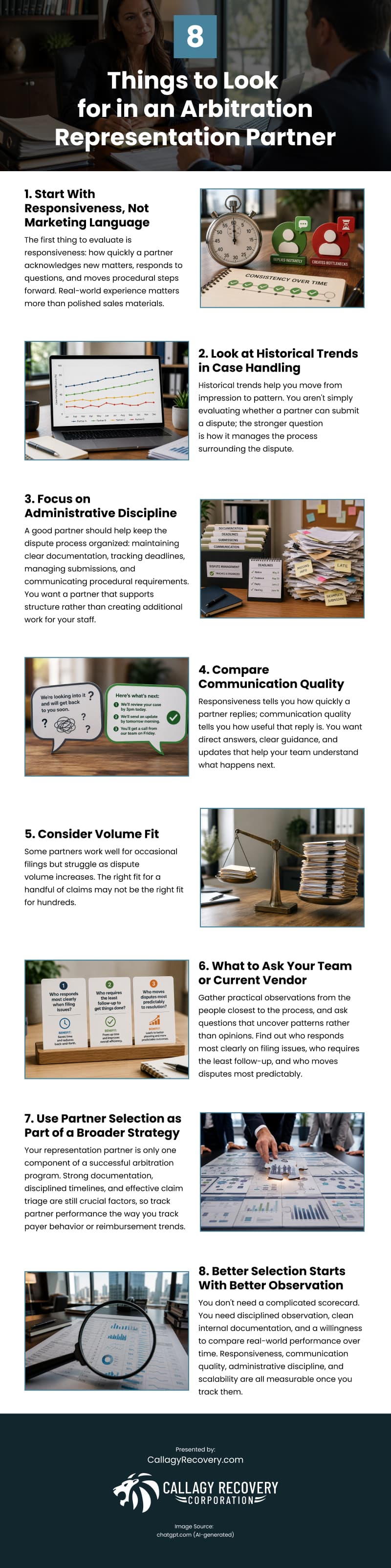
When selecting an arbitration representation provider, it is crucial to evaluate responses and communication, rather than relying solely on marketing materials, to make an informed and confident decision. Explore eight things to look for in an arbitration representation partner in this infographic.