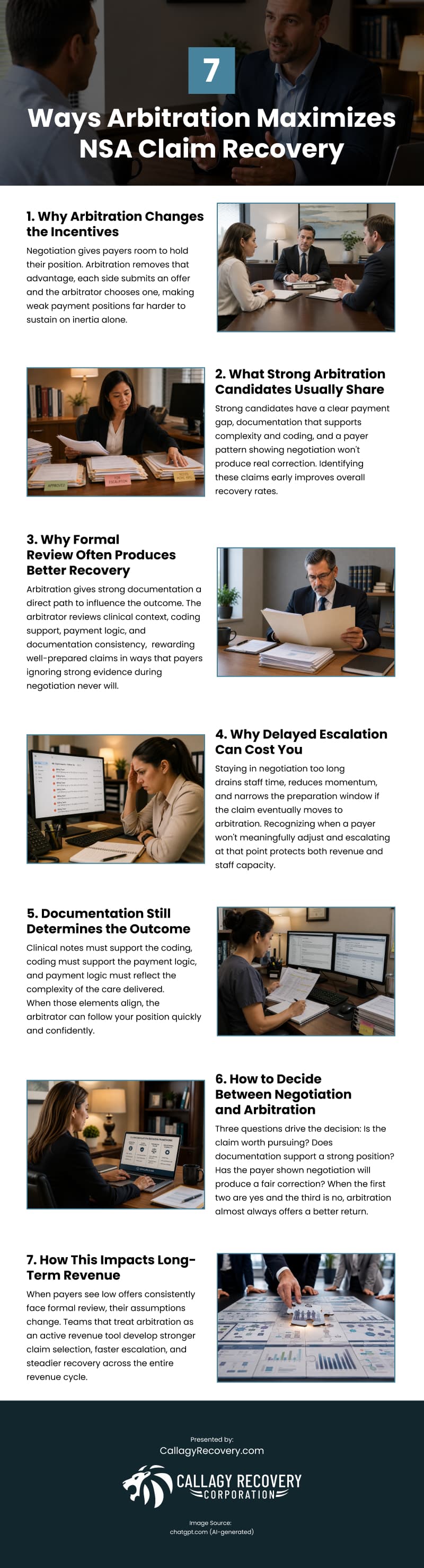

When you handle No Surprises Act claims, open negotiation is the required first step. It gives both sides a chance to resolve the payment dispute before formal review begins. In practice, that stage often produces low movement, slow responses, or token adjustments that do very little to close the gap. If you stop your strategy there, you may leave meaningful revenue on the table.
That happens because negotiation usually keeps the payer in control of the pace and the framing. The insurer can delay, repeat the same position, or issue a slightly improved number that still falls short of fair reimbursement. Your team may spend time responding, tracking, and following up without creating much pressure for a real correction. The process stays active, but the claim doesn’t move toward a stronger financial result.
Arbitration changes that dynamic. Once a claim reaches formal dispute resolution, the conversation shifts from payer discretion to structured review. And with the help of an NSA claim representation company, you can use that shift in your favor.
Why Arbitration Changes the Incentives
Negotiation gives the payer room to hold its line. Arbitration introduces consequences for doing that. In Federal IDR, each side submits an offer, and the certified arbitrator chooses one. That creates a different incentive structure because the insurer can no longer assume that time and attrition will work in its favor.
You gain an advantage when the claim moves into a setting where evidence matters more than internal payer logic. The arbitrator reviews the documentation, the payment reasoning, and the statutory factors tied to the claim. That makes it much harder for a weak or artificially low payment position to survive on inertia alone.
This doesn’t mean every claim should go straight to arbitration. It means you should view arbitration as a serious recovery path rather than a last resort. When the facts are strong and the payment gap is significant, formal dispute resolution often gives you a better chance of full recovery than prolonged negotiation.
What Strong Arbitration Candidates Usually Share
Some claims are better built for arbitration than others. You improve your recovery rate when you identify those claims early and move them forward with discipline.
Strong candidates often have these traits:
- A clear gap between the insurer’s payment and the likely value of the service: Larger differences create more room for meaningful recovery and justify the time spent preparing the dispute.
- Documentation that clearly supports the complexity, acuity, and coding of the service: A clean record gives the arbitrator a stronger reason to choose your offer.
- A payer pattern that suggests negotiation won’t produce a real correction: Repeated low offers or formulaic responses often signal that formal review will be more productive than more back-and-forth.
When these factors line up, arbitration tends to offer more upside than continued negotiation.
Why Formal Review Often Produces Better Recovery
Arbitration works best when your claim is organized around what the arbitrator actually reviews. That usually includes the clinical context, the strength of your coding support, the logic behind your payment amount, and the consistency of your documentation. A well-prepared file allows the arbitrator to see why your number better reflects the service.
Negotiation doesn’t always reward that kind of preparation. A payer may ignore strong documentation if its strategy is to hold low through the open negotiation window. That’s why arbitration gives your evidence a more direct path to influence the outcome. Medical claim arbitration representation makes an even bigger difference, especially in claims where the care was complex, the patient was high acuity, or the provider’s expertise played a significant role.
You also gain more structure in arbitration. The process has deadlines, submission standards, and a formal decision point. That structure helps stronger claims stand out.
Why Delayed Escalation Can Cost You
Some providers stay in negotiation mode too long because they hope another follow-up will produce movement. That delay can drain staff time and reduce momentum. It can also narrow your internal preparation window if the claim eventually moves into arbitration.
When a payer has already shown that it won’t meaningfully adjust, continuing to negotiate often adds friction without increasing recovery. Your team ends up doing more work in a setting where the payer still controls the response. That’s why timing is so crucial. You want to recognize when negotiation has served its purpose and when formal dispute resolution offers a better return on effort.
A disciplined escalation strategy protects both revenue and staff capacity. Instead of letting claims drift, you move them into the venue more likely to produce a stronger result.
Documentation Still Determines the Outcome
Arbitration creates leverage, but documentation still carries the case. You don’t get higher recovery just because the dispute entered formal review. You improve results when your records make the value of the service easy to understand.
That means the clinical notes should support the coding. The coding should support the payment logic. The payment logic should reflect the type of care delivered, the complexity involved, and the relevant benchmarks. If those elements align, the arbitrator can follow your position quickly and confidently.
This is one reason arbitration often outperforms negotiation for stronger claims. It gives clear documentation a better chance to influence your outcome.
How to Decide Between Continued Negotiation and Arbitration
A practical decision usually comes down to three questions:
- Is the claim worth enough to pursue aggressively?
- Does the documentation support a strong payment position?
- Has the payer shown any real sign that negotiation will produce a fair correction?
If the answer to the first two questions is yes and the third is no, arbitration often makes more sense. The more that payer behavior looks rigid, the more value there is in shifting to a process where an outside reviewer evaluates the record.
You should also look at claim volume and workflow. If your team sees repeated underpayments from the same payer for similar services, it may be more efficient to build an arbitration-focused strategy instead of treating each negotiation like it will lead to a new outcome.
How This Impacts Long-Term Revenue
Choosing arbitration over extended negotiation can improve more than one claim. It can change how you manage underpayments across your revenue cycle. When payers see that low offers are more likely to face formal review, their assumptions about provider follow-through can change.
You also gain stronger internal discipline. Teams begin to sort claims more clearly, prepare evidence earlier, and treat negotiation as one stage in a broader recovery strategy rather than the main event. Over time, that produces better claim selection, faster escalation, and steadier recovery.
The strongest NSA recovery strategies usually treat arbitration as an active revenue tool. When the claim is right, formal dispute resolution often gives you a better path to the payment the service actually supports.
Video
Infographic
Arbitration shifts NSA claim recovery from payer discretion to a structured review in which evidence determines the outcome, giving well-prepared claims a far better path to full recovery than prolonged negotiation alone. Discover ways arbitration maximizes NSA claim recovery in this infographic.