
Being a surgeon means dedicating your time and expertise to your patients. But when it comes to getting paid for your work, insurers don’t always value that expertise fairly. If you perform out-of-network procedures, you’ve likely faced inconsistent reimbursements, delayed payments, or flat-out underpayments that fall well below your billed rates.
The No Surprises Act (NSA) was meant to bring fairness to the process, but for many surgical practices, it has added another layer of complexity. You can no longer balance-bill patients for out-of-network services. Instead, you must rely on negotiation and arbitration to secure the compensation you deserve.
That’s why understanding how to manage, document, and defend your out-of-network claims is essential. Securing out-of-network claim recovery for surgeons doesn’t have to be a daunting process. With the right strategy, you can turn a frustrating procedure into a reliable source of recovered revenue.
1. Ensure Documentation is Comprehensive and Precise
Strong documentation is your first line of defense against underpayments. Every out-of-network claim should include detailed operative notes, pre- and post-procedure documentation, and supporting records that demonstrate medical necessity.
Insurers often look for gaps in documentation to justify reducing payment or denying claims. When your submission includes precise, complete records that connect diagnoses to procedures and clearly show the complexity of care, you limit their ability to dispute reimbursement.
You should also make sure your coding team uses the correct CPT and ICD-10 codes, along with appropriate modifiers that accurately reflect what occurred in the operating room. Even small errors, like missing a modifier or misreporting laterality, can cost you thousands per claim.
2. Leverage the No Surprises Act Arbitration Process
If you’re not yet using the NSA’s Independent Dispute Resolution (IDR) process, you’re making a huge mistake. Arbitration allows you to challenge low insurer offers for out-of-network services through a neutral third-party review.
When executed correctly, arbitration can yield five to ten times more reimbursement than the insurer’s initial payment. That can translate to thousands, possibly even millions. The process requires attention to detail, including strict adherence to timelines and accurate submission of all required materials.
As a surgeon, arbitration is especially valuable because you often perform procedures where insurers undervalue the time, skill, and resources involved. Whether it’s an emergency surgery, an out-of-network consult, or a procedure at an in-network facility, IDR help by arbitration experts can help you recover fair compensation for your expertise.
3. Track Timelines Rigorously
The NSA imposes tight deadlines for each step of the out-of-network dispute process. Once you receive an initial payment or denial, you have 30 days to initiate negotiation, followed by a limited window to file for arbitration if no agreement is reached.
Missing even one of these deadlines forfeits your right to dispute the claim. To stay on top of this, establish an internal tracking system that automatically flags important dates. Alternatively, work with a recovery partner who manages timelines for you, ensuring that no eligible claim slips through the cracks.
Timeliness is critical. Every day lost can mean lost revenue.
4. Audit Old Claims for Missed Opportunities
You may be surprised to learn that many underpaid or denied claims from the past few years are still recoverable. The NSA and various state laws allow providers to revisit older cases that were underpaid or incorrectly denied, especially if they meet arbitration eligibility.
By conducting a retrospective audit, you can identify previously written-off claims that qualify for dispute. Many surgeons discover that they have years’ worth of recoverable revenue waiting to be claimed.
A recovery audit, particularly one powered by advanced analytics, can highlight patterns, such as insurers consistently underpaying specific CPT codes or misapplying their own payment policies. Once identified, these patterns can be addressed through arbitration or appeals to recover funds you may have considered lost.
5. Strengthen Collaboration Between Clinical and Billing Teams
Your billing team is only as effective as the clinical information they receive. In surgery, details matter, and the same goes for billing. Billing specialists need your input to accurately code, document, and justify procedures.
Make it a priority to establish clear communication channels between your clinical staff and billing team. When you proactively share detailed operative notes, clarify procedures, and flag unique circumstances, you give your billing experts the tools they need to support your claims effectively.
Encourage your staff to hold regular cross-departmental reviews of denied or underpaid claims. These meetings often uncover recurring insurer issues or documentation gaps that you can correct going forward.
6. Partner With Specialists in Out-of-Network Revenue Recovery
Navigating out-of-network claims under the No Surprises Act is time-consuming and technically complex. Rather than stretching your in-house team beyond capacity, consider partnering with professionals who specialize in medical revenue recovery and arbitration.
A trusted recovery partner handles claim review, documentation, data analysis, and arbitration filings on your behalf. The best part is that many operate on a contingency basis, meaning you pay nothing up front. They’re compensated only when they recover money for you.
This approach eliminates risk while maximizing your results. By outsourcing these efforts, you protect your team’s time and ensure that every claim is handled with the expertise and precision required for success.
7. Use Data to Identify Underpayment Trends
Insurers tend to repeat the same patterns. By analyzing your claims data, you can identify where and how they consistently underpay. For example, you may notice a specific insurer undervalues certain surgical codes or frequently denies add-on procedures.
Tracking these trends helps you build stronger arbitration cases. It also allows you to make strategic decisions, such as which claims to prioritize and how to negotiate more effectively before arbitration.
Data analytics turns guesswork into strategy. The more you understand how insurers operate, the better equipped you are to recover the revenue you’re owed.
8. Treat Every Out-of-Network Claim as an Opportunity
It’s easy to become frustrated with the administrative burden of NSA compliance, but every out-of-network claim represents potential income. When managed strategically, these claims can add up to significant gains for your practice or surgical group.
The key is to stay proactive. Track claims carefully, document meticulously, and challenge every underpayment that qualifies for arbitration. Insurers rely on provider fatigue to save money, but when you stay consistent, you flip the balance in your favor.
By making out-of-network recovery a routine part of your revenue cycle, you build long-term financial resilience and protect your team from unnecessary write-offs.
Recover What You’ve Earned
You’ve already done the hard work. Now it’s time to make sure you get paid for it. The No Surprises Act may have changed how you handle out-of-network claims, but it also created powerful tools to help you recover what’s rightfully yours.
By tightening your documentation, embracing arbitration, and partnering with experts who understand the process, you can maximize every eligible claim. You can reclaim revenue that supports your staff, strengthens your operations, and rewards your dedication to patient care.
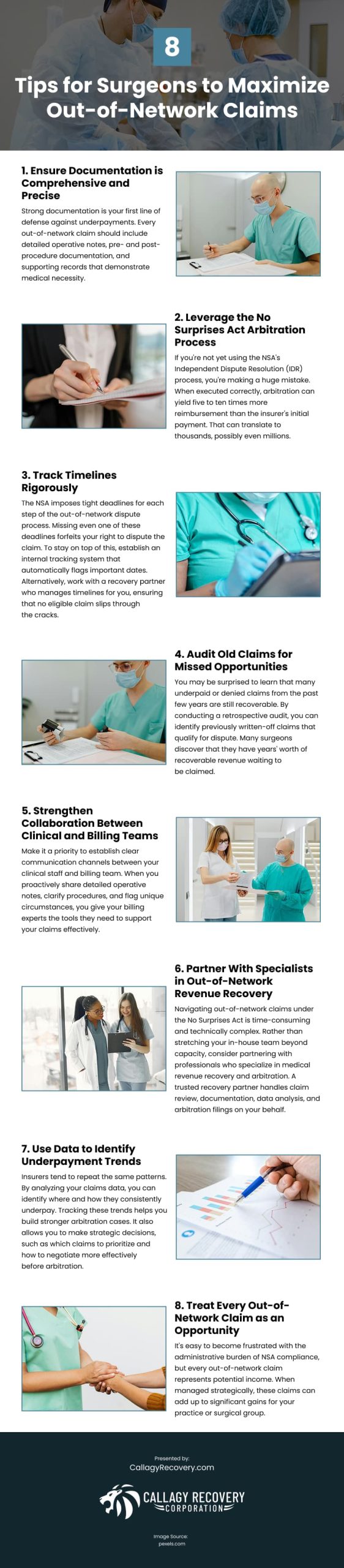
Infographic
The No Surprises Act has reshaped how surgical practices handle out-of-network claims, demanding more precise documentation, stricter timelines, and a more strategic approach to securing full reimbursement. This infographic shares key tips to help surgeons maximize their out‑of‑network claims.