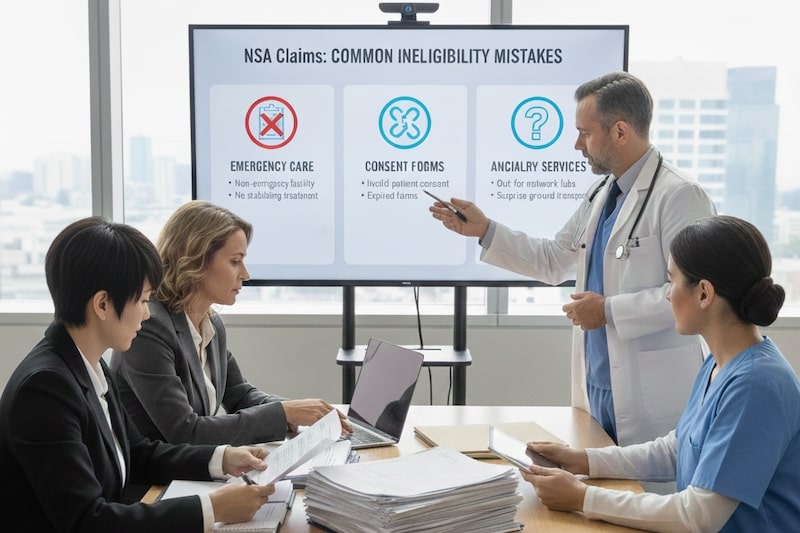
If you’ve been navigating the No Surprises Act (NSA) claims process, you already know it’s not simple. Between strict timelines, evolving regulations, and insurer pushback, it’s easy to assume that some claims just don’t qualify for arbitration.
But if you assume that, you couldn’t be more wrong. Many of the cases you dismiss as ineligible actually do qualify. And that misunderstanding could be costing your organization significant revenue.
The NSA was created to protect patients from surprise medical bills while ensuring providers receive fair compensation. Yet, confusion about eligibility has become one of the biggest barriers to recovery. By investing in NSA claims review and recovery, you can turn missed opportunities into measurable revenue gains.
Why Eligibility Confusion Happens
The NSA’s complexity is one of its greatest challenges. It overlaps with state-level surprise billing laws, includes multiple exceptions, and demands strict adherence to timelines. Insurers often take advantage of this confusion, suggesting certain claims can’t be arbitrated when, in fact, they can.
You and your team may avoid filing some claims simply to avoid wasted time or filing fees. But that hesitation can lead to thousands, even millions, of dollars lost annually. Understanding where misinterpretations commonly occur is the key to maximizing your reimbursement potential.
1. Out-of-Network Emergency Services
One of the most common areas of misunderstanding involves out-of-network emergency care. Many providers assume that if a patient has been stabilized or transferred, the claim no longer qualifies under the NSA. However, the law clearly covers emergency services regardless of where they are delivered, including post-stabilization care that’s deemed medically necessary.
You might have provided emergency treatment at an in-network hospital but were out-of-network as a provider (for example, anesthesiology, radiology, or emergency medicine). In this case, your claim likely qualifies for arbitration. Even if the insurer labels it “ineligible,” that doesn’t mean they’re correct.
2. Ancillary Services at In-Network Facilities
Another commonly misunderstood category is ancillary services provided by out-of-network specialists working in in-network hospitals. The NSA explicitly includes these services under its protection, yet many providers skip arbitration because insurers argue that these claims don’t apply.
For example, if you’re an out-of-network radiologist, pathologist, or anesthesiologist treating a patient at an in-network facility, your services are covered. You can’t balance-bill the patient, but you can use arbitration to secure full reimbursement from the insurer.
This is one of the most overlooked claim categories because insurers frequently downplay its eligibility. But when you know the law, you can challenge those denials confidently and recover what you’re owed.
3. Air Ambulance and Emergency Transport Claims
Air ambulance and emergency transportation services are another area of confusion. Many providers assume these claims are automatically excluded from arbitration because they involve special billing categories or cross-state transport.
In reality, air ambulance claims are explicitly covered under the NSA. The law recognizes that patients rarely have a choice in who provides emergency transport, so it ensures these services qualify for arbitration when underpaid. If your organization provides these services, you shouldn’t accept low insurer offers or write off disputes as ineligible.
4. Claims Falling Under Both State and Federal Jurisdiction
If your organization operates in a state with its own surprise billing laws—such as New York, New Jersey, or Texas—you may face additional confusion about whether to file under the federal NSA or the state’s process. Many providers mistakenly believe they can’t pursue arbitration under either law because they’re unsure which applies.
Here’s the key: if a state has its own law governing certain claims, that law usually takes precedence. However, any claims not covered by state law default to the federal NSA process. This means many out-of-network claims that seem excluded under state rules still qualify under federal arbitration.
Pursuing out-of-network claim recovery by arbitration experts is vital. These teams help you determine the best route for each claim and ensure you never miss a valid opportunity.
5. Services Provided in Nontraditional or Hybrid Care Settings
Another category often overlooked involves hybrid or nontraditional care environments, such as freestanding emergency centers, urgent care facilities, or telemedicine consultations associated with emergency services.
Providers sometimes assume that if care wasn’t rendered inside a hospital, it’s not eligible for arbitration. But that’s not always true. If the care falls within the NSA’s emergency service definitions or is tied to a patient’s emergency episode of care, it may still qualify.
For instance, telemedicine providers involved in post-emergency follow-ups can sometimes pursue arbitration if their services are part of an emergency-related billing dispute. It’s a nuanced area, but one worth investigating instead of dismissing outright.
How Misunderstood Claims Cost You Money
Every time you assume a claim is ineligible, you potentially lose thousands in revenue. Insurers are counting on that. They know that confusion and administrative fatigue make it easy for providers to abandon disputes. Over time, those unfiled claims add up to millions in unrecovered funds for hospitals, surgical centers, and physician groups.
Your goal shouldn’t just be to avoid mistakes but to capture every legitimate opportunity for reimbursement. By challenging insurer assumptions and verifying eligibility with experts, you ensure your organization gets the full payment it deserves.
How to Ensure You’re Not Missing Eligible Claims
To stop leaving money on the table, you need a consistent process for reviewing and filing NSA claims. That means:
- Clarifying eligibility early: Confirm which claims qualify under federal vs. state arbitration laws before dismissing them.
- Tracking timelines closely: Establish systems that monitor filing deadlines so no valid case expires.
- Leveraging experienced partners: Work with specialists who understand the nuances of NSA arbitration and can identify hidden opportunities.
These steps turn the NSA process from a guessing game into a reliable source of revenue recovery.
Don’t Assume
The biggest mistake providers make under the No Surprises Act isn’t missing deadlines or paperwork errors. It’s assuming certain claims aren’t worth pursuing. When you clarify eligibility and use arbitration strategically, you uncover revenue streams that insurers hope you’ll ignore.
Arbitration ensures that your hard work and patient care are rewarded with fair compensation. Don’t assume your claim is ineligible. Use the power of arbitration to your advantage.
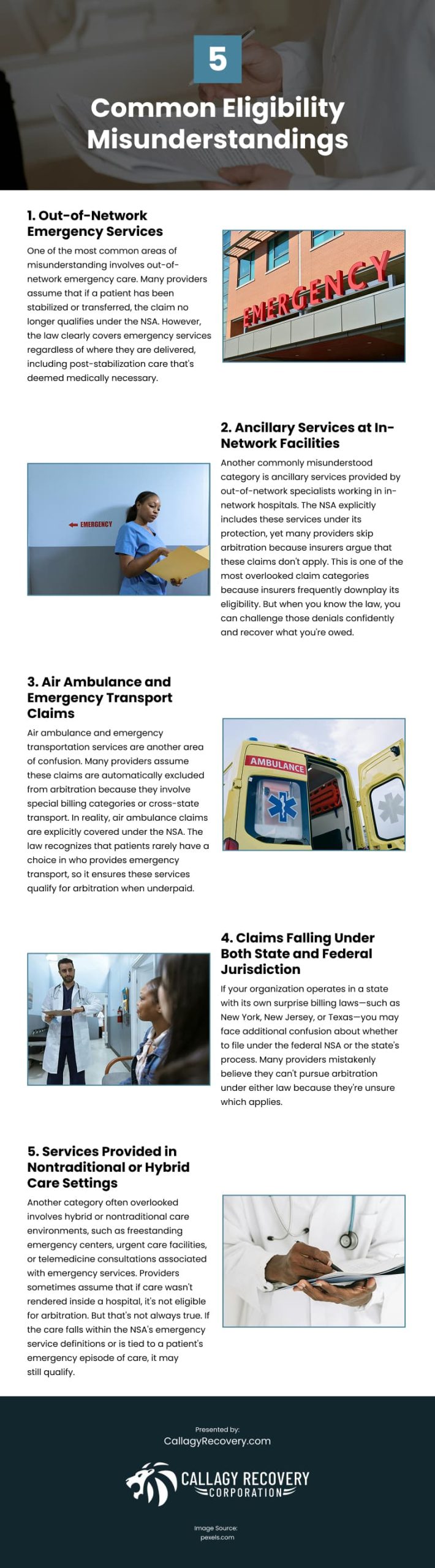
Infographic
The No Surprises Act helps providers secure fair reimbursement, but its complexity often leads to misunderstandings that insurers exploit. Many providers miss out by assuming certain claims aren’t eligible for arbitration. This infographic highlights common eligibility mistakes to help prevent lost earnings.